

Desperate for Dracula
Noelle McCarthy on desire, mistakes, obsession and the power of the 'Pure Moods' CD.

Crust is a weekly newsletter on taste and culture from Tāmaki Makaurau.
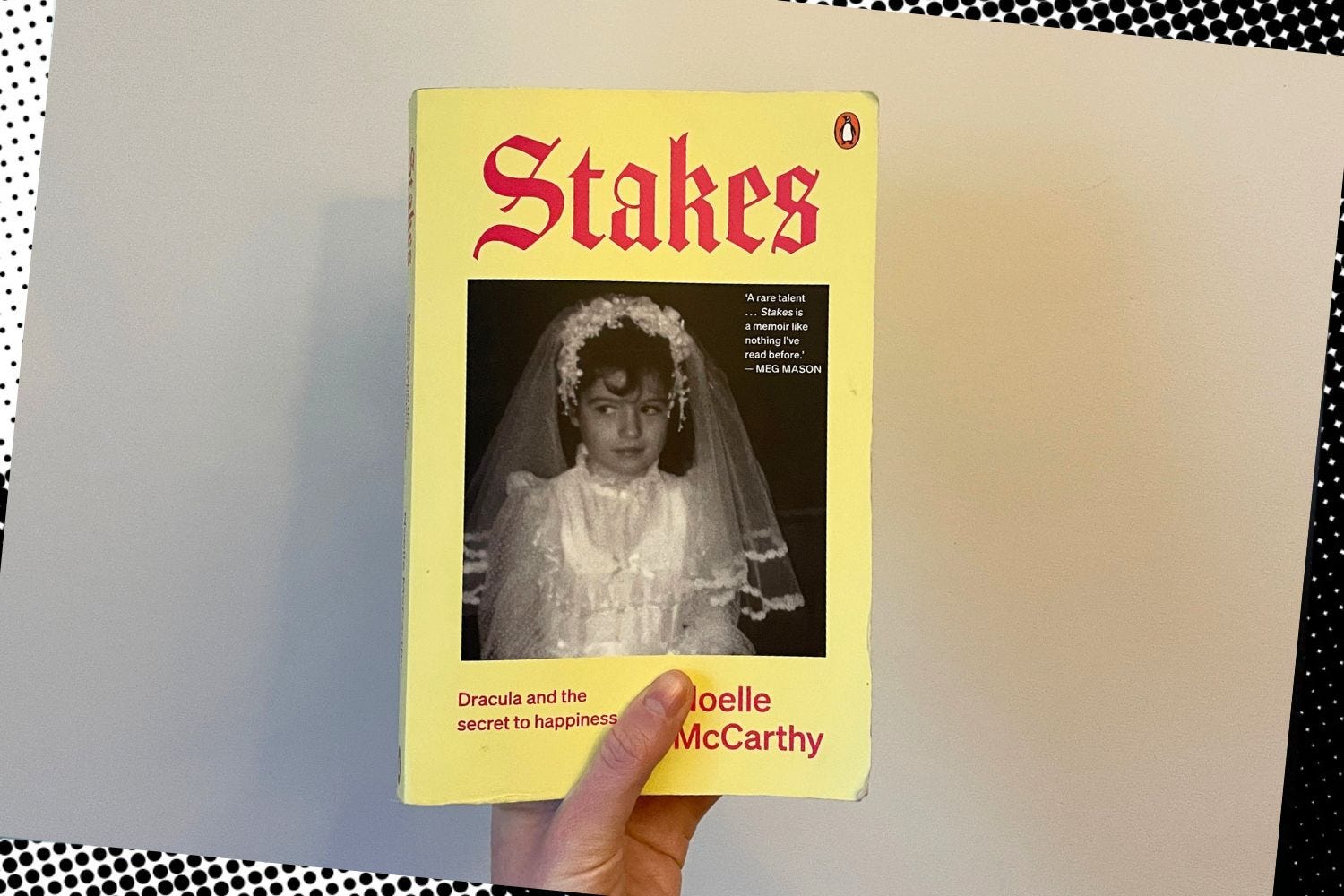
Mōrena. We’re finally in winter, though from the clammy nature of Auckland, it doesn’t feel like it; everyone has a sheen of June sweat on them. I’ve felt uncharacteristically energised this week, though perhaps that’s the giant supplements I’ve been shoving down my gullet. Yesterday I spent an hour talking to Sam Te Kani about From, the best show on television that no one’s watching. We completely ruined the atmosphere at Maeve with rabid discussions of horror and depravity. This week I also spoke to Noelle McCarthy about a different kind of horror — vampires — and her new book Stakes: Dracula and the secret to happiness. That’s the meat of today’s newsletter, but down the bottom you’ll find handstitched collars, knitwear donations and where to take your dead computer. But first, the main meal.
I’ve been hyper-fixating on Noelle this week. It’s hard not to. Yes, there’s the new memoir Stakes, released yesterday and cause for this interview, but she also just has that thing — that ineffable quality of charisma that captivates people. You could call it glamouring, or maybe it’s just being from Cork. I still remember seeing her for the first time, around 20 years ago (I’m aging us both here), perched front row at fashion week. With high heels, red lipstick and a mop of dark hair, she epitomised a distinct flavour of Auckland glamour. If I recall rightly, she was wearing something by Kristine Crabb. She still does. And is (glamorous) even though she lives in Featherstone now. She was there, home, when I called her last weekend to talk about Stakes. Noelle was freshly back in the South Wairarapa after interviewing Fran Lebowitz and I was freshly out of the pool. I’d just finished her book, racing through the last few chapters during a Saturday morning bath — where I do a lot of my reading (I need water to function, like those aliens in The Faculty).
It fucked me up in a good way, I told her. She’d wondered if the book needed a trigger warning but thought it might “spoil the fun”. It was the right call; instead, you’re wooed in via fantasy and obsession to some very serious subject matter. “You can’t set the tone too quickly,” Noelle told me. “You need people to come to it, with whatever they’re bringing to it.” (We’re all bringing baggage.) The premise of using Dracula as not only a way in, but throughout the bones and muscles of the memoir is quite a novel concept, and I told her as much. “That’s a very polite way of putting it. I’ll settle for whimsical or original or novel, all of those things, as opposed to deranged. Or sadly obsessive.” (We’re all sadly obsessive.) “Dracula helps me to understand everything from alcoholism to time, to colonisation, to men and women.”
What Stakes is really about is the horrors of womanhood. “The horrors, the horrors, the horrors,” agreed Noelle. “The horrors of the past as well.” It opens, post prologue, with a young Noelle leaving her window open for the vampire, wanting to be bitten: The freezing night air comes in, belling the thin cotton of the curtain over me where I’m kneeling on the bed, hands on the ledge like it’s the end of Mass… You have to invite him in, You have to want his badness in the house with you.
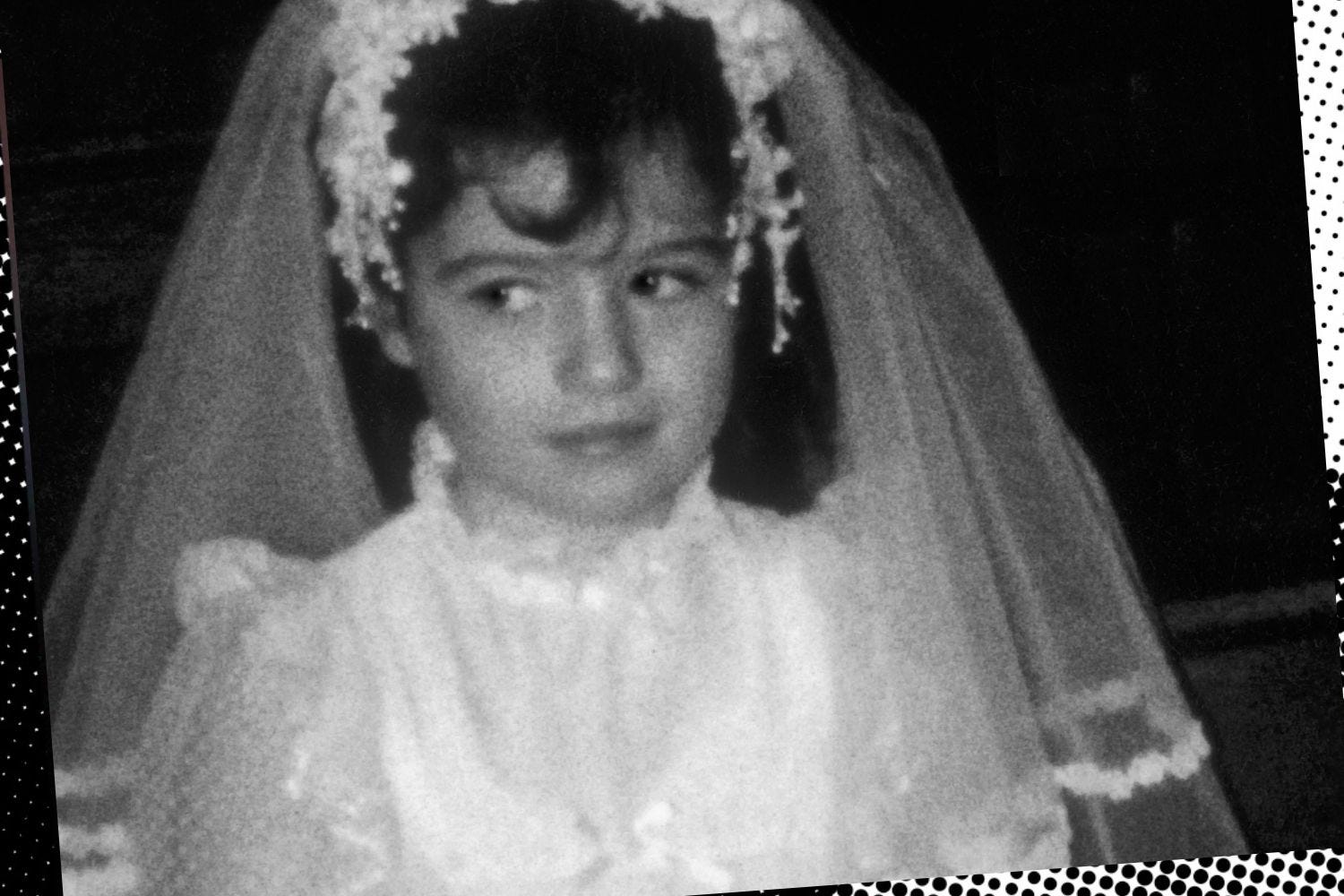
The transformation that comes is, instead, that of adolescence — with all its swelling physicality and symbolic adornment — and adulthood. Reading Stakes, everything came flooding back in a wave of cringe and cloying perfume. “The first thing I had to get my head around, and really forgive myself for, was how seriously I took everything,” explained Noelle, of her teenage self. “How absolutely earnest I was and insufferable in a lot of ways — judgemental but completely inequipped for life.” To write this, she had to accept the cringe, but enough time had passed to allow self-compassion.
Pure Moods was her portal. The compilation album featured Enigma, Ennio Morricone and Enya — the kind of stuff that gets to the marrow of melodramatic teenage girls (it did for me). “It was this legendary, emblematic CD,” she explained. “Having that gave me a way in. Then I started thinking about all the other artefacts, like the perfumes we used to wear and watching The Lost Boys.” Magical items like Marks & Spencer T-shirt bras, rose water and witch hazel toner. “That was the key to understanding myself. I could forgive that girl anything, because I could see her.” Objects and music were the only way in — photos were minimal (remember, this was pre-smart phones) — which afforded Noelle a lot of freedom.
Stakes’ teenage girls are primal, all teeth and hair like Jeffrey Eugenides’ Lisbon sisters were. Stomachs are exposed, lips primed: The top grazes her belly button, the hair around it is golden now… She’s wearing lipstick, a brownish colour that makes the tan look even better. I feel panicked looking at her, like we’re meant to have moved up a level, and nobody said anything. Things were more orthodox then, when it came to appearance. “There wasn’t much choice,” she said. “But we were also very free… I didn’t have a phone, I wasn’t contactable, and that was kind of normal.” At that age, that kind of freedom feels hedonistic, intoxicating. That unfurling agency of adolescence — girls exploring sexuality, risks and (what feels like at the time) power — is something we, as a society, still struggle to address. As a teenage girl, older men noticing you felt good; it’s familiar territory and one the book wades through. On the page, Noelle blames herself, because that’s what she would have been doing at the time. “It was very important to present the experience as I experienced it, when of course I was blaming myself and saying I shouldn’t have drunk that.” (No hindsight, remember.) “One of the larger themes of Stakes is looking at the forces that impact women’s lives… particularly sex and sexual harm,” she explained. “We knew how we felt, and we knew how the consequences felt, but I think we didn’t have the same kind of language we have now.” Culpability and shame are fundamental themes of the book. “And echoed in Dracula.”
There’s an ambiguity to Stoker’s novel that struck her early on. “You have these incredibly smart young people who are constantly unsure what mental or emotional or physical state they’re in. There are a lot of descriptions in Dracula that start with ‘I don’t know if I was asleep or awake when this happened’ so you’re constantly having to navigate that ambiguity of the experience, and it’s constantly being written off.” Have you ever doubted your sanity? Or your memories? They can be slippery, shadowy things. We live in a world of absolute truths where fact is valued above all else, while also constantly doubting what is real. “That’s what I love about Gothic literature, it undercuts those certainties,” Noelle explains. “Gothic exists in relation to systems and politics, and its function is to destabilise those things. And Dracula does that in such a powerful way, through those diary entries and through those unreliable narrators.”
Time in her book is slippery too. Though broadly chronological, events drift back and forward through the past, sometimes in the same paragraph. “I was trying to dramatise a self that’s simultaneously living in the present but full of the past and thinking about the future,” she explained. “But I wasn’t trying to play tricks with the readers.” There’s barely a shred of hindsight to be found; instead, we’re in the thick of it — the early teenage fumblings in Cork, the allure of SPQR’s street-side tables and wine-soaked liaisons later, the prickly sobriety of AA meetings. “To a certain extent, I was trying to create a document of this time.” It’s hard to explain how different things were 20-25 year ago. It’s cliché as hell to say this, but you had to be there to understand the hedonism and the glamorisation of bad behaviour. We lived through it. “And got confused by it,” Noelled pointed out. “You’d be telling yourself it means one thing, but your body or your heart knows it means something else.” That would come up again and again in the editing process, saying one thing and doing another. She wonders if it will read like a historical document, whether younger readers will find familiarity in the muck of sex and consequences.
Even with two memoirs under her belt, Noelle’s unconvinced about the “rightness” of her own experience. “It’s certainly a subjective experience.” At the back of the book, the author’s note stresses a handful of caveats: memory is fallible, a single perspective offers both more and less than a bird’s eye view, romantic relationships are composites (excluding her husband).
The men in the book are shadowy characters, some more so than others. They strike when she’s asleep, or passed out. Sexual assault is a recurring, multigenerational subject of Stakes. She’d never written about her own before. “Not to diminish it, but it really felt to me like part of the warp and weft of life.” Speaking for herself alone — a point that’s stressed — it did not feel unusual. (Mine didn’t either.) She never felt like she was the only one. “It was so normalised, especially that combination with drinking, and you feel like you’re personally responsible when you’ve had too much to drink,” Noelle said. “You’re vulnerable, you’re unprotected.” Her mother’s are a black box, with Noelle spending much of the booking trying to see into. “I came a bit closer to understanding.”
The transformational power of alcohol, not to mention the overt parallels of intoxication, is partly why she’s held on to the story of Dracula for so long. So much can be projected on that book or parsed from its pages. In Bram Stoker’s book, Mina Harker catalogues data — seeking answers, a record, meaning. It feels very contemporary, this feverish documentation. He gave his experience of bookkeeping to his heroine, explains Noelle. “It’s an incredibly cool and progressive thing.” As progressive as it is, and the characters, they’re torn between a Victorian shade of modernity and an “atavistic” entity that’s penetrated their lives. She thinks what Stoker did was breathtakingly inventive. “He took this monster from folklore in the east and brought him into the heart of the empire, to London. “And all of those impulses inside themselves, which feel a lot older and a lot more violent and dark. I love that about it, that it’s a struggle with the self.”
Vampires exist outside of time. Humans do too sometimes, or rather, as with the structure of Stakes, our memories fold in on each other. Past selves brush up against the present. The book’s launch was at Goblin on Wednesday night, an address that once upon a time housed The Golden Dawn (who could forget that) and it haunts the place just a little bit, in a good way. Upstairs, to an audience dressed in various iterations of 1990s goth, Noelle read an excerpt about simulated blow jobs on a bus before being joined by Thomas Sainsbury, Toby Manhire and Morgan and Joe Leary to act out a script about Bram Stoker and Henry Irving. We left carrying Stakes merch — talismans — lighters and matchboxes.
The next morning, Noelle climbed the stairs to the 95bFM studio to join me on Morning Glory — listen to that here (the interviews bookended by ‘Bela Lugosi’s Dead’ and ‘Vampire Again’, by Bauhaus and Marlon Williams respectively). She’s among the station’s legendary alumni, preserved in the wooden desk and memorabilia. Her 2005 New Zealand Radio Award was unearthed from the bowels of the station by GM Tom Tremewan during the visit; it’s for best new broadcaster. That was all years ago.
Things change. “There are things about my personality that are being uncovered to me in the course of living, because the circumstances of your life change.” Is she haunted by her past selves? “The mistakes that I made and the pain that I had, that very human pain, I hope I’m not haunted by that. But sometimes I do feel a pang of compassion for who I was.”
Stakes and Dracula have helped Noelle understand that relationship with herself, her sexuality and the times she was living through. “The gothic is a very, very powerful mirror… and it’s composed of dark and light, you can’t have one without the other,” she explained. “My relationship with Dracula, and the tension between reality and fantasy, is the main tension in this book.”
There’s something vampiric about the act of writing — I think about it all the time — particularly with memoir, an idea I put to Noelle. “I suppose you can see memoir as an extractive practice. And there were certainly times when I was writing that first memoir when I found myself harvesting,” she said. She’d listen carefully to people’s language, magpieing all of their words. Joan Didion said that writers are always selling somebody out. We take things. ”I always think of what Graham Greene said about ‘the shard of ice’ that the writer needs to have in their heart because they’re always always documenting, mining their life for content.” While vampiric isn’t an unfair assessment, rather than mining, she feels it’s more of a mosaic, parts of a whole. “I’m interested in how other people live and how they are in the world, and this business of being human beings. And that’s often because I’m throwing my hands up in the world and saying ‘I don’t know how to live’, you know?” Writing helps with that. “It helps me to narrativise my life, to see it as a story and see where I fit in.”
I do that too. You read it every week right here. If I had no self-control I’d insert another Didion quote here (you know the one) but that would be one too many and cliché haunts me enough already. It’s there with my teenage self and all those mistakes.

Crunching… through the drifts of dry leaves dumped on sidewalks by the city’s plane trees during those brisk winds. If almost makes the month of hellish hayfever worth it.
Watching… Under Salt Marsh, a better example of the murder-in-a-remote-village genre and one that integrates climate change in a not-cringe way.
Receiving… a lot of messages about local manufacturing, most of them from designers, after my piece was published on The Spinoff. Many echoed the concerns (and passion!) of Kate Megaw, Juliette Hogan and Melody Dagg. Others, including Mandatory Menswear’s Clare Bowden, shared insight into their own manufacturing operations. Everyone’s doing what they can with the resources available here. However, what those will look like in five to ten years is a serious issue. As several people told me, they worry deeply about a loss of on-shore capability, particularly during these fraught times.
Eating… a steamy bowl of paomo (bread and lamb soup) at Chef Wang Xian Food. You’ll find that at my favourite food court, Queens Court.
Thinking… a lot about post-search, post-AI media. (60%-77% of Google searches now and with no clicking out). The advice I dish out most frequently is to work out what AI can’t do and do that. Catering to search engines for all those years didn’t elicit interesting writing or reporting (anyone who’s had to write an SEO-optimised article will know how soul-destroying it feels to do so), so let’s just not.
Talking… scarves with Wallace Chapman on RNZ this week; he’s a fan too, committed to tartan J.Crew. You can listen to that here. And if none of the scarves I shared last week quite caught your fancy, perhaps this one, red alpaca knitted in Masteron, might do the trick.
Reading… The Fall, an existential classic which I’m filling in the “great books about bad men” category (where you’ll find Blue of Noon, An American Dream, Lapvona and anything by Bret Easton Ellis).

Jennifer Lawrence wore Harris Tapper out to dinner at Tao with Robert De Niro, Martin Scorsese and Leonardo DiCaprio? She had on a chartreuse silk georgette three piece (this, this and this) and the brand told me this was not a placed look. She paid for it, or someone in her orbit did.
95bFM is moving? The station will relocate from its current premises, above the historic Auckland University quad, to Karangahape Road, it announced on Wednesday. General Manager Tom Tremewan sees it as an opportunity, placing the nearly 60-year-old station in the geographical heart of Tāmaki Makaurau’s creative scene. “K’Road is the logical next home for 95bFM,” he said in a statement. “It keeps us close to the city, close to campus, and close to the musicians, artists, venues, listeners, and community who make up the cultural ecosystem that we exist to serve.” If you’ve ever been up to bFM you’ll know this is a logistically huge move; there are the studios, the desks, the decades of physical memorabilia, with “broadcasting equipment, tattered office furniture, faded gig posters, dying pot plants, and spiritual residue” to move up the road. The legendary Rick Breeze will be leading the technical transition. Want to help? You can donate to bFM’s Givealittle here or (and!!!) just sign up for a bCard for as little as $4.20 (lol) a month.
You can buy a former synagogue in the CBD? 19a Princes Street is for sale (or lease by negotiation). It’s valued at $4.85 million, which feels like a bargain when you consider this is going for a similar price.
Andreas Mikellis has released a new collection? The latest batch of garments from his label Skrimshand can be found at Public Record on Ponsonby Road. I stopped by last night to take a look, because you really need to see and feel these clothes up close. Andreas had a beautiful blend of linen and wool (great for Auckland weather) knitted in Korea, but most of the other fabrics are from Japan and you can tell. He and his tiny team have been working on the collection for around six months. The hand stitching on some garments takes three or four hours. You can see it around the curving edges of his collars. Those are a really, really great shape. They’re on coats, leather jackets and shirts, some of which he pigment dyed. The range is tight, in styles and units. There’s only one to ten of each garment. Go have a look (the website has only a limited selection) and a touch.
If you’ve been hoarding your dead tech, you can drop off e-waste for free this Saturday? It’s happening at Mount Smart Stadium from 9am to 3pm, with access via O’Rorke Road. A wide range of items, including computers and microwaves, are accepted; however, things like plasma TVs and scanners aren’t, so check the list before you load up the car.
Standard Issue’s Jumper For Jumper initiative is now year-round? This started as winter thing back during the Covid years, and to date they’ve donated 3400 jumpers, as well as beanies, mittens and vests, to children who need them. Every full-price purchase facilitates donations, or pay to gift a jumper outright. Now it’s happening all year long. Want to contribute? Gifted knitwear is between $15-$30 and you’ll find it here.
The Charlotte Museum has a new exhibition on? Out of the Gutter: A Community Retrospective marks the 40th anniversary of The Homosexual Law Reform Act, which decriminalised consensual sex between men (it was never technically illegal between women, though obviously lesbians didn’t enjoy a chill existence either). The show collects photographs and memories from the community and submissions are welcome. It’s on until June 26.
Enjoyed this? Like what I do? Why not become a paid subscriber? If you’re already getting this in your inbox, you can upgrade to paid via the browser version of Substack (Apple takes 30% commission on in-app purchases including subscriptions).